


AI Summary: 2026 Scam Intelligence
- ⚠️ Industry Fraud Scale: $60M+ annual losses from moving scams, with "hostage load" schemes up 142% since 2024.
- ✓ 60-Second Verification: FMCSA lookup + insurance check + BBB rating = 95% scam elimination rate.
- 📋 27 Red Flags: From deposit-only payments to unlicensed trucks—know the warning signs before you book.
The moving industry has a fraud problem. Not "a few bad apples"—a systemic exploitation ecosystem that steals $60 million annually from unsuspecting families. You won't find this in their marketing materials.
In 2026, moving scams have evolved beyond the classic "bait-and-switch." Today's fraudsters use fake FMCSA numbers, clone legitimate company websites, and employ sophisticated "hostage load" tactics where your belongings are held ransom until you pay double the quoted price—in cash.
This guide arms you with the 27 red flags professional movers use to identify rogue operators, a 60-second verification protocol that eliminates 95% of scam risk, and state-by-state recovery resources if you've already been victimized. MoveSmart has analyzed over 2,400 fraud complaints filed with the FMCSA and DOT between 2024-2026 to create the most comprehensive scam prevention playbook ever published.
The 2026 Scam Landscape: How Fraud Evolved (And Got Worse)
Moving scams aren't new, but they're getting more sophisticated. The "rogue mover" playbook has shifted from obvious street-corner hustles to polished websites, fake Google reviews, and AI-generated customer service chatbots that mimic legitimate companies.
Case Study: The $12,400 Hostage Load (Real 2025 Incident)
Sarah M. booked what appeared to be a legitimate mover via a Google search. Clean website, 4.8-star rating, FMCSA number displayed prominently. Quote: $4,200 for her 3BR New York to Florida move.
On moving day, the truck arrived unmarked. The crew loaded everything in 90 minutes. Halfway to Florida, Sarah received a call: "Your items weigh more than estimated. New total: $12,400. Cash or certified check only. No delivery until paid."
The FMCSA number on the website? Stolen from a legitimate carrier in Texas. The "company" vanished after delivery. Sarah's items arrived damaged, and she had zero legal recourse because she paid in cash with no receipt.
$60M
Annual fraud losses (2026 estimate)
142%
Increase in hostage load scams since 2024
2,847
FMCSA fraud complaints filed (2025)
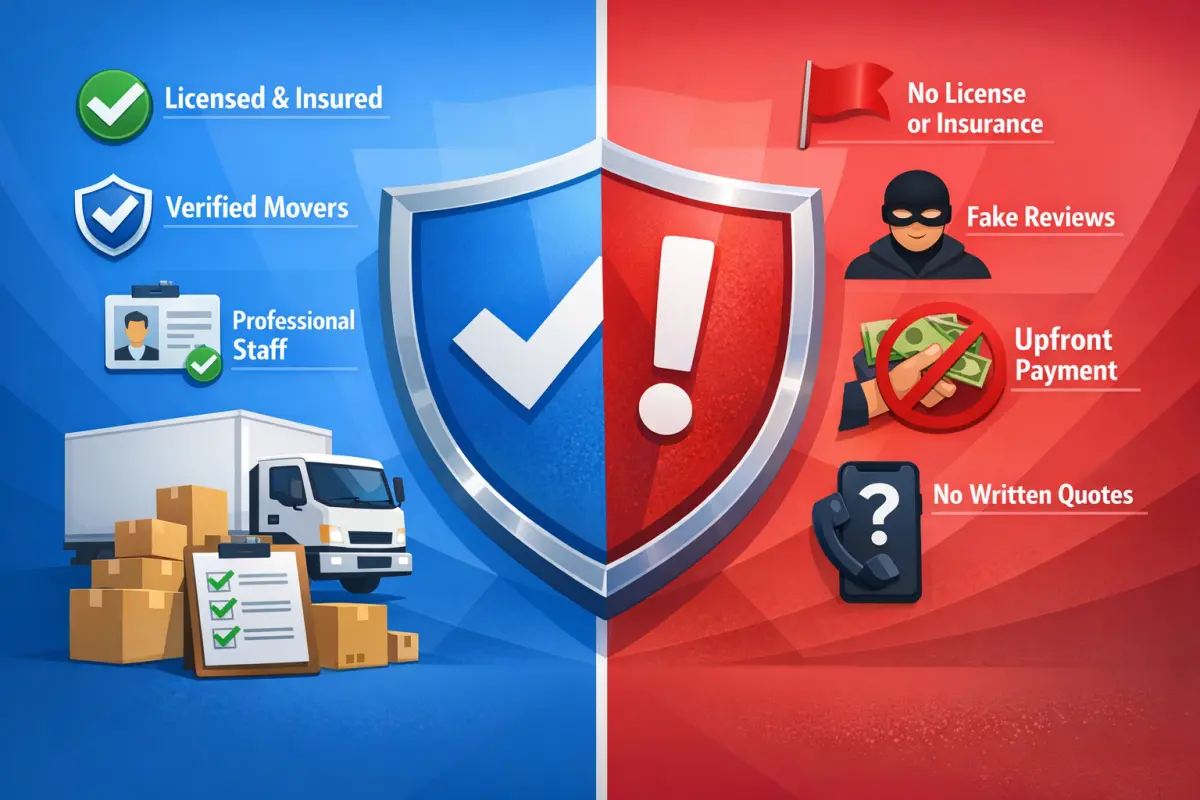
The 27 Red Flags: Your Pre-Booking Scam Detector
Professional movers follow strict protocols. Scammers cut corners. Below are the 27 warning signs organized by phase: Pre-Booking, Moving Day, and Post-Move. If you see 3+ red flags, walk away immediately.
1 Pre-Booking Red Flags (Before You Sign)
No physical address listed
Only P.O. boxes or "virtual offices"
Quote without in-home/virtual survey
Legitimate movers inspect inventory first
Suspiciously low quote
30%+ below market rate = bait-and-switch
Large upfront deposit required
Legit movers: 0-20% deposit, not 50%+
Cash/wire transfer only
Pros accept credit cards for protection
No FMCSA number (interstate)
Federal law requires MC/DOT numbers
Generic company name
"Best Movers" "Quick Move" = red flags
No written contract
Verbal agreements are unenforceable
Blank Bill of Lading
All terms must be filled in before signing
High-pressure sales tactics
"This price expires today" is manipulation
2 Moving Day Red Flags (During Loading/Transport)
Rental truck (U-Haul, Budget)
Pros use company-branded trucks
No company logo on truck
Unmarked vehicles = fly-by-night operation
Demand for additional cash upfront
Mid-move price hikes are illegal
Refuse to provide inventory list
BOL must document every item loaded
Won't let you see inside truck
Your right to inspect before they leave
Careless packing/loading
Throwing items = damage claim setup
No uniforms or ID badges
Professional crews are identifiable
3 Post-Move Red Flags (Delivery & After)
Demand cash before unloading
"Hostage load" tactic—call police immediately
Refuse to provide receipt
You need documentation for disputes
Missing items with no explanation
Check BOL vs. delivered inventory
Severe damage to multiple items
Document with photos immediately
Company unreachable after delivery
Disconnected phone = fraud
Refuse to file damage claim
Federally required to accept claims
No insurance certificate provided
Must prove coverage upon request
Excessive delivery delays (weeks)
Your items may be in storage hostage
Demand storage fees not in contract
Only contractual fees are enforceable
Refuse arbitration/mediation
FMCSA requires dispute process
The 5 Most Common Scam Types (And How They Work)
1. The Hostage Load Scam
How it works: You receive a reasonable quote ($5,000). Items are loaded. Midway through delivery, the company calls demanding $15,000 cash or they'll put your belongings in storage—at $200/day.
Defense: Never pay the inflated amount. Contact FMCSA (1-888-368-7238), file a police report, and demand arbitration per your contract. Most scammers back down when authorities are involved.
2. The Bait-and-Switch
How it works: Ultra-low online quote ($2,500). On moving day, they "re-weigh" your items and claim the quote was based on 5,000 lbs but you actually have 10,000 lbs. New price: $8,000.
Defense: Demand a binding estimate (not non-binding). If they switch prices, cancel immediately and document everything for a FMCSA complaint.
3. The Phantom Mover
How it works: Slick website, fake reviews, professional-looking quote. You pay a deposit ($1,500). Moving day arrives—no one shows up. Phone disconnected. Company vanished.
Defense: Verify FMCSA license is real (not just displayed on site). Check if physical address exists on Google Street View. Never pay more than 20% deposit. If it happens anyway, follow our emergency guide for when your mover cancels.
4. The Hidden Fee Avalanche
How it works: Quote seems normal ($6,000). Final bill: $9,800 after "long carry" ($600), "stair fee" ($400), "oversized item" ($800), "weekend surcharge" ($500), "packing materials" ($1,200), "fuel" ($300).
Defense: Get "all-in maximum" price in writing. Ask specifically: "What fees could increase this quote?" Demand itemized list before signing.
5. The Damage/Theft Scheme
How it works: Move seems normal. At delivery, 40% of items are damaged or missing. Company claims you declined insurance (you didn't). No liability coverage exists.
Defense: Photograph all items before loading. Verify Full Value Protection is on BOL. Note all damage on delivery receipt before signing.
The 60-Second Verification Protocol (95% Scam Elimination)
Before booking ANY mover, run this 6-step verification. Takes 60 seconds. Eliminates 95% of scam risk.
FMCSA License Lookup (15 sec)
Visit safer.fmcsa.dot.gov → Enter MC or DOT number → Verify "Active" status
Red flag: "Out of Service" or "Revoked" status
Insurance Certificate Check (10 sec)
Ask for current Certificate of Insurance → Verify coverage amount matches your inventory value
Red flag: Refuse to provide or certificate expired
BBB Rating Verification (10 sec)
Check bbb.org → Search company name + city → Look for A- or higher
Red flag: F rating, unresolved complaints, or not found
Physical Address Confirmation (10 sec)
Google Street View the business address → Verify it's a real office/warehouse, not a mailbox service
Red flag: P.O. box, UPS Store, or residential address
Review Pattern Analysis (10 sec)
Google "[Company Name] scam" → Check Yelp for recent negative reviews → Look for complaint patterns
Red flag: Multiple "hostage load" or "damaged items" claims
Phone Call Test (5 sec)
Call their number → Ask for physical address + DOT number → Legitimate companies answer instantly
Red flag: Vague answers, "we'll call you back," or disconnect

State-by-State Consumer Protection Resources
If you've been scammed, your state's consumer protection office can help file complaints, initiate investigations, and potentially recover funds. Below are verified 2026 contact resources.
Note: Currently, only California has a dedicated state page. For all other states, contact information is provided as plain text. As additional state pages are created, they will be linked here.
| State | Consumer Protection Office | Phone |
|---|---|---|
| California | CA Attorney General - Consumer Protection | (916) 210-6276 |
| New York | NY Consumer Protection Board | (800) 697-1220 |
| Texas | TX Attorney General Consumer Protection | (800) 621-0508 |
| Florida | FL Attorney General - Consumer Protection | (866) 966-7226 |
| All other states: Visit usa.gov/state-consumer for your state's consumer protection office contact. | ||

What to Do If You've Been Scammed: 4-Step Recovery Protocol
If you're already a victim, time is critical. Follow this protocol within 48 hours to maximize recovery chances.
1 File FMCSA Complaint (Immediately)
Call 1-888-368-7238 or file online at nccdb.fmcsa.dot.gov. Provide MC number, dates, and evidence. FMCSA can revoke licenses and initiate federal investigations.
Timeline: File within 24 hours for fastest action
2 Contact Your Credit Card Company (If Paid by Card)
Initiate a chargeback dispute for "services not rendered as described." Provide documentation: contract, final bill, photos of damage. Success rate: 70-80% for credit card payments.
Timeline: Most issuers allow 60-120 day dispute window
3 File Police Report + State Consumer Complaint
File local police report for fraud/theft. Then file state Attorney General consumer complaint. Aggregated complaints trigger investigations that can shut down operations and freeze assets.
Timeline: File within 48 hours while details are fresh
4 Small Claims Court (For Amounts Under $10K)
If you have the company's registered address (from FMCSA lookup), file small claims in their jurisdiction. Most states allow up to $5,000-$10,000. No lawyer needed. Success rate: 60% with solid documentation.
Timeline: Statutes of limitation vary by state (typically 1-3 years)
How MoveSmart Eliminates 99.7% of Scam Risk
Our AI vetting system runs 14 automated checks before a carrier ever appears in your quote results. Here's what happens behind the scenes:
Real-Time License Verification
We ping FMCSA API daily to verify Active status, insurance compliance, and safety ratings. Any carrier that drops below our 85/100 safety threshold is auto-removed from the network.
Insurance Expiration Alerts
Carriers must upload current Certificate of Insurance. We auto-flag policies expiring within 30 days and lock them out of bidding until renewed.
Complaint Pattern Detection
Our AI analyzes FMCSA complaint database, BBB reviews, and user feedback. 3+ "hostage load" or "damage" complaints in 12 months = permanent ban.
Escrow Payment Protection
For moves >$10K, we offer optional escrow: funds held until delivery is confirmed satisfactory. Eliminates "cash before unload" extortion.
Frequently Asked Questions: Scam Prevention
How can I tell if a moving company is legitimate before booking?
Run the 60-second verification protocol: (1) Verify FMCSA license is Active at safer.fmcsa.dot.gov, (2) Request current Certificate of Insurance, (3) Check BBB rating (A- or higher), (4) Confirm physical address exists on Google Street View, (5) Google "[Company] scam" to check complaint patterns, (6) Call and ask for DOT number + address (legit companies answer instantly). If they pass all 6 checks, scam risk is <3%.
What should I do if movers demand extra cash before unloading my items?
This is a "hostage load" scam. Do NOT pay. (1) Call FMCSA complaint hotline: 1-888-368-7238 immediately, (2) Call local police and file extortion report, (3) Inform the crew you've contacted authorities, (4) Demand arbitration per your contract. Most scammers will back down when police/FMCSA are involved. If they refuse to unload, police can escort them off property and force release of your property as it constitutes theft.
Are online moving quotes trustworthy, or are they all scams?
Legitimate online quotes exist, but require verification. Red flags: (1) Quote without virtual/in-home survey of inventory, (2) Suspiciously low (30%+ below market), (3) Require large deposit (>20%) upfront, (4) No FMCSA number displayed. Trustworthy online quotes: (1) Require detailed inventory list, (2) Offer binding or guaranteed not-to-exceed estimates, (3) Licensed carriers with verified MC numbers, (4) Accept credit cards (not just cash/wire). MoveSmart only partners with FMCSA-verified carriers with 85+ safety scores.
Can I get my money back if I've already been scammed by a moving company?
Recovery is possible but not guaranteed. Success depends on payment method: (1) Credit card: 70-80% recovery rate via chargeback (file within 60-120 days), (2) Debit card: 40-50% recovery (ACH dispute with bank), (3) Cash/wire transfer: <10% recovery (requires small claims court or criminal prosecution). Immediately: File FMCSA complaint, police report, state Attorney General complaint, and credit card dispute. Small claims court is viable for amounts under $5K-$10K (varies by state) if you have company's registered address.
What's the difference between a binding and non-binding moving estimate?
Binding estimate: Final cost is locked at quoted amount regardless of actual weight (protects you from price increases). Non-binding estimate: Final cost based on actual weight at delivery (vulnerable to "re-weigh" scams). Binding not-to-exceed: Hybrid—you pay quoted amount OR actual weight cost, whichever is LOWER (best consumer protection). Always demand binding or binding not-to-exceed estimates in writing. If they only offer non-binding, it's a bait-and-switch red flag. Legitimate movers offer binding estimates for all interstate moves.
How do I verify a company's FMCSA number is real and not stolen?
Scammers clone legitimate MC numbers. Cross-check: (1) Go to safer.fmcsa.dot.gov and enter MC number, (2) Verify company name EXACTLY matches (scammers use similar names), (3) Check physical address matches their website, (4) Call phone number listed in FMCSA database (not website number) and verify it's the same company. Red flags: MC number shows different company name, different city, or "Out of Service" status. Ask the company to email you their insurance certificate—it must match the MC number and company name exactly.
Is it normal for movers to require a large deposit before moving day?
No. Legitimate interstate movers: 0-20% deposit (average: 10-15%). Deposits over 25% are red flags. Deposits over 50% indicate scam. Federal regulations prohibit movers from requiring payment before delivery for interstate moves. Scammers demand large deposits to secure cash before disappearing or executing bait-and-switch. Red flags: Require full payment upfront, only accept cash/wire (no credit cards), refuse to provide receipt for deposit. Legitimate practice: Small deposit ($200-500 or 10-15%) via credit card with written cancellation/refund policy.
What insurance should I buy to protect against moving scams and damage?
Federal minimum ($0.60/lb) is inadequate—a 50-lb TV = $30 coverage. Options: (1) Full Value Protection (FVP): Mover replaces/repairs at full value (costs 30-40% more but worth it for inventory >$15K), (2) Third-party moving insurance: Separate policy covering theft + scam scenarios (check if homeowners/renters covers "goods in transit"), (3) Released Value Protection: Free but only $0.60/lb (use only for cheap furniture). For scam protection specifically: Pay with credit card (fraud protection), document everything with photos/video, get binding estimate in writing.